 Add to Chrome
 Add to Firefox
 Add to Edge
eMoT: evolving Memory-of-Thought via Symbolic Anchoring and Memory Corrosion
Jun 01, 2026
While Large Language Models (LLMs) achieve impressive performance on multi-step reasoning tasks, their reliability is persistently hindered by critical limitations such as unconstrained hallucinations and poor numerical computation. Fundamentally, these issues arise because standard models treat reasoning as a transient, one-off generation process rather than retaining and refining successful procedural logic. To address these challenges, we propose eMoT (evolving Memory-of-Thought), a unified framework that stabilizes multi-step reasoning by treating reasoning trajectories as dynamic, evolving memories rather than static templates. The framework primarily consists of three interconnected modules: (i) a memory corrosion mechanism that reinforces high-utility reasoning structures while gradually decaying less frequent ones; (ii) a symbolic anchoring engine that utilizes Python for deterministic computation, much like a human uses a calculator; and (iii) a consistency-driven refinement process that aligns neural inference with symbolic outcomes, reducing the accumulation of logical discrepancies. Across multiple reasoning benchmarks, eMoT improves accuracy and solution consistency over standard Chain-of-Thought and structured reasoning baselines.On the traditional task Game of 24, eMoT achieves 100% accuracy, surpassing the baseline by up to 17.6%. Evaluations on mathematical task GSM8K, ASDiv, SVAMP, and MGSM further show consistent gains in multi-step mathematical reasoning. In our evaluation, we achieve superior performance despite utilizing a lightweight backbone model with constrained baseline capabilities. Compared to alternative methods that rely on massively scaled models, our results demonstrate that the performance gains are fundamentally driven by the eMoT framework's reasoning control rather than sheer model size.

Where to Look: Can Foundation Models Reach a Target Viewpoint Through Active Exploration?
May 31, 2026Humans can reproduce the viewpoint specified by a target image through active head and body motion, yet spatial intelligence in foundation models has largely been studied as passive understanding of pre-collected observations. We introduce Target Viewpoint Reproduction (TVR) -- an active task where an agent adjusts its viewpoint in a 3D environment until its observation matches a given target image -- and TVRBench, an indoor-simulation benchmark spanning scene scale and target-view visual richness. TVR is far from solved: on the evaluation split, the strongest open-source and closed-source models reach only 7.8% and 12.0% success. Fine-grained analysis identifies two consistent bottlenecks: off-the-shelf models struggle with multi-turn visual history, and performance drops sharply when viewpoint reproduction requires body translation rather than in-place rotation, exposing a gap in mapping spatial discrepancies to embodied movement. To study reducing this gap, we build a unified TVR post-training framework covering expert-trajectory SFT, rationale-supervised CoT-SFT, offline Single-turn GRPO, and on-policy Multi-turn GRPO from live simulator rollouts. Visual-action SFT supplies the main gain, raising a 9B open-source model to 50.8% success; Multi-turn GRPO provides targeted multi-room refinement and reaches 51.4% overall, while CoT supervision and Single-turn GRPO degrade closed-loop performance. These results establish TVRBench as a testbed for measuring and training foundation models that actively perceive and act in 3D environments. Our code, data, and models are available at https://github.com/aim-uofa/TVRBench.
From Talking to Singing: A New Challenge for Audio-Visual Deepfake Detection
May 27, 2026With rapid advances in audio-visual generative models, reliable forgery detection becomes increasingly critical. Existing methods for audio-visual deepfake detection typically rely on cross-modal inconsistencies. In singing, rhythmic vocalization weakens this coupling and introduces a nontrivial domain shift, substantially degrading detection performance. We construct the Singing Head DeepFake (SHDF) dataset using rhythm-aware generative models to fill the gap in singing benchmarks. To cope with cross-scenario domain shifts, we propose a Text-guided Audio-Visual Forgery Detection (T-AVFD) framework that generalizes across both talking and singing scenarios. T-AVFD comprises a facial authenticity pattern learner and a multi-modal differential weight learning module. The pattern learner aligns facial features with multi-granularity textual descriptions to learn generalizable authenticity patterns. The weight learning module preserves intrinsic audio-visual consistency and adaptively integrates it with authenticity patterns via differential weighting. Extensive experiments on multiple talking head deepfake datasets and SHDF show consistent improvements over existing baselines and strong robustness under diverse perturbations.
LEGO: LoRA-Enabled Generator-Oriented Framework for Synthetic Image Detection
May 06, 2026The rapid advancement of generative technologies has made synthetic images nearly indistinguishable from real ones, thereby creating an urgent need for robust detectors to counter misinformation. However, existing methods mainly rely on universal artifact features that are shared across multiple generators. We observe that as the diversity of generators increases, the overlap of these common features gradually decreases. This severely undermines model generalization. In contrast, focusing only on unique artifacts tends to cause overfitting to specific forgery patterns. To address this challenge, we propose LEGO (LoRA-Enabled Generator-Oriented Framework). The core mechanism of LEGO employs an MLP to modulate multiple LoRA (Low-Rank Adaptation) blocks, each pretrained to capture the unique artifacts of a specific generator, followed by attention-based feature fusion. Unlike conventional methods that seek a single universal solution, LEGO delegates unique artifact extraction to specialized LoRA modules by dividing its training procedure into two stages. Each LoRA module is individually trained on a single-generator dataset to learn generator-specific representations, then MLP and attention layers are trained on mixed datasets to dynamically regulate the contribution of each module. Benefiting from its modular yet robust design, LEGO can be naturally extended by incorporating new LoRA modules for adaptation to newly emerging next-generation datasets, while still achieving substantially better performance than prior SOTA methods with fewer than 30,000 training images, less than 10% of their training data, and only 5 epochs in each training stage.
Enhancing Self-Supervised Talking Head Forgery Detection via a Training-Free Dual-System Framework
May 05, 2026Supervised talking head forgery detection faces severe generalization challenges due to the continuous evolution of generators. By reducing reliance on generator-specific forgery patterns, self-supervised detectors offer stronger cross-generator robustness. However, existing research has mainly focused on building stronger detectors, while the discriminative capacity of trained detectors remains insufficiently exploited. In particular, for score-based self-supervised detectors, the limited discriminative ability on hard cases is often reflected in unreliable anomaly ordering, leaving room for further refinement. Motivated by this observation, we draw inspiration from the dual-system theory of human cognition and propose a Training-Free Dual-System (TFDS) framework to further exploit the latent discriminative capacity of existing score-based self-supervised detectors. TFDS treats anomaly-like scores as the basis of System-1, using lightweight threshold-based routing to partition samples into confident and uncertain subsets. System-2 then revisits only the uncertain subset, performing fine-grained evidence-guided reasoning to refine the relative ordering of ambiguous samples within the original score distribution. Extensive experiments demonstrate consistent improvements across datasets and perturbation settings, with the gains arising mainly from corrected ordering within the uncertain subset. These findings show that existing self-supervised talking head forgery detectors still contain underexploited discriminative cues that can be effectively unlocked through training-free dual-system reasoning.
Scalable Adaptation of 3D Geometric Foundation Models via Weak Supervision from Internet Video
Feb 08, 2026Geometric foundation models show promise in 3D reconstruction, yet their progress is severely constrained by the scarcity of diverse, large-scale 3D annotations. While Internet videos offer virtually unlimited raw data, utilizing them as a scaling source for geometric learning is challenging due to the absence of ground-truth geometry and the presence of observational noise. To address this, we propose SAGE, a framework for Scalable Adaptation of GEometric foundation models from raw video streams. SAGE leverages a hierarchical mining pipeline to transform videos into training trajectories and hybrid supervision: (1) Informative training trajectory selection; (2) Sparse Geometric Anchoring via SfM point clouds for global structural guidance; and (3) Dense Differentiable Consistency via 3D Gaussian rendering for multi-view constraints. To prevent catastrophic forgetting, we introduce a regularization strategy using anchor data. Extensive experiments show that SAGE significantly enhances zero-shot generalization, reducing Chamfer Distance by 20-42% on unseen benchmarks (7Scenes, TUM-RGBD, Matterport3D) compared to state-of-the-art baselines. To our knowledge, SAGE pioneers the adaptation of geometric foundation models via Internet video, establishing a scalable paradigm for general-purpose 3D learning.
TeachPro: Multi-Label Qualitative Teaching Evaluation via Cross-View Graph Synergy and Semantic Anchored Evidence Encoding
Jan 14, 2026Standardized Student Evaluation of Teaching often suffer from low reliability, restricted response options, and response distortion. Existing machine learning methods that mine open-ended comments usually reduce feedback to binary sentiment, which overlooks concrete concerns such as content clarity, feedback timeliness, and instructor demeanor, and provides limited guidance for instructional improvement.We propose TeachPro, a multi-label learning framework that systematically assesses five key teaching dimensions: professional expertise, instructional behavior, pedagogical efficacy, classroom experience, and other performance metrics. We first propose a Dimension-Anchored Evidence Encoder, which integrates three core components: (i) a pre-trained text encoder that transforms qualitative feedback annotations into contextualized embeddings; (ii) a prompt module that represents five teaching dimensions as learnable semantic anchors; and (iii) a cross-attention mechanism that aligns evidence with pedagogical dimensions within a structured semantic space. We then propose a Cross-View Graph Synergy Network to represent student comments. This network comprises two components: (i) a Syntactic Branch that extracts explicit grammatical dependencies from parse trees, and (ii) a Semantic Branch that models latent conceptual relations derived from BERT-based similarity graphs. BiAffine fusion module aligns syntactic and semantic units, while a differential regularizer disentangles embeddings to encourage complementary representations. Finally, a cross-attention mechanism bridges the dimension-anchored evidence with the multi-view comment representations. We also contribute a novel benchmark dataset featuring expert qualitative annotations and multi-label scores. Extensive experiments demonstrate that TeachPro offers superior diagnostic granularity and robustness across diverse evaluation settings.
R$^{2}$Seg: Training-Free OOD Medical Tumor Segmentation via Anatomical Reasoning and Statistical Rejection
Nov 16, 2025Foundation models for medical image segmentation struggle under out-of-distribution (OOD) shifts, often producing fragmented false positives on OOD tumors. We introduce R$^{2}$Seg, a training-free framework for robust OOD tumor segmentation that operates via a two-stage Reason-and-Reject process. First, the Reason step employs an LLM-guided anatomical reasoning planner to localize organ anchors and generate multi-scale ROIs. Second, the Reject step applies two-sample statistical testing to candidates generated by a frozen foundation model (BiomedParse) within these ROIs. This statistical rejection filter retains only candidates significantly different from normal tissue, effectively suppressing false positives. Our framework requires no parameter updates, making it compatible with zero-update test-time augmentation and avoiding catastrophic forgetting. On multi-center and multi-modal tumor segmentation benchmarks, R$^{2}$Seg substantially improves Dice, specificity, and sensitivity over strong baselines and the original foundation models. Code are available at https://github.com/Eurekashen/R2Seg.
MELDAE: A Framework for Micro-Expression Spotting, Detection, and Automatic Evaluation in In-the-Wild Conversational Scenes
Oct 26, 2025Accurately analyzing spontaneous, unconscious micro-expressions is crucial for revealing true human emotions, but this task remains challenging in wild scenarios, such as natural conversation. Existing research largely relies on datasets from controlled laboratory environments, and their performance degrades dramatically in the real world. To address this issue, we propose three contributions: the first micro-expression dataset focused on conversational-in-the-wild scenarios; an end-to-end localization and detection framework, MELDAE; and a novel boundary-aware loss function that improves temporal accuracy by penalizing onset and offset errors. Extensive experiments demonstrate that our framework achieves state-of-the-art results on the WDMD dataset, improving the key F1_{DR} localization metric by 17.72% over the strongest baseline, while also demonstrating excellent generalization capabilities on existing benchmarks.
Learning Generalizable and Efficient Image Watermarking via Hierarchical Two-Stage Optimization
Aug 12, 2025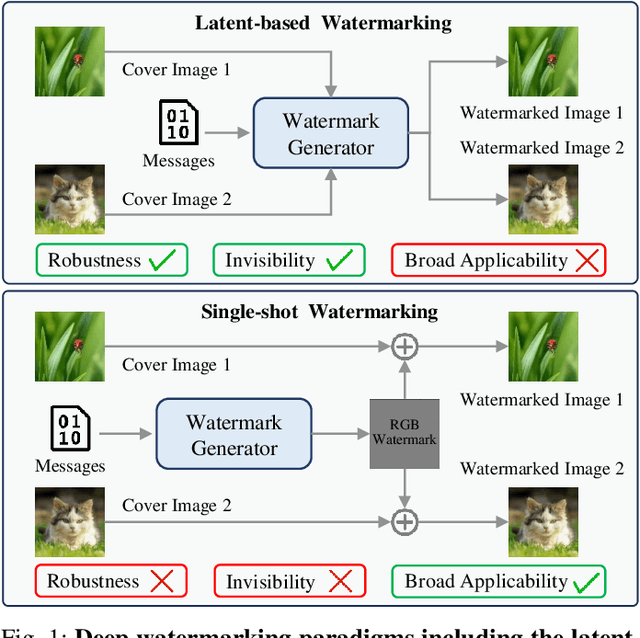
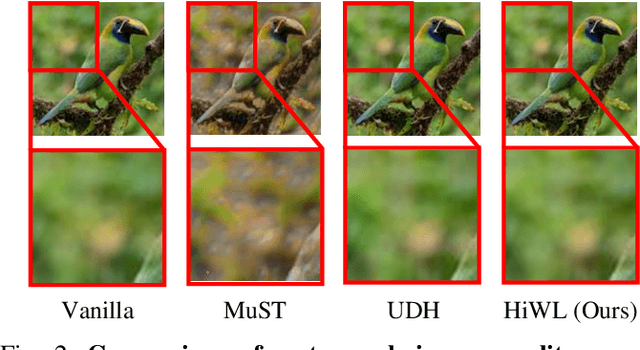
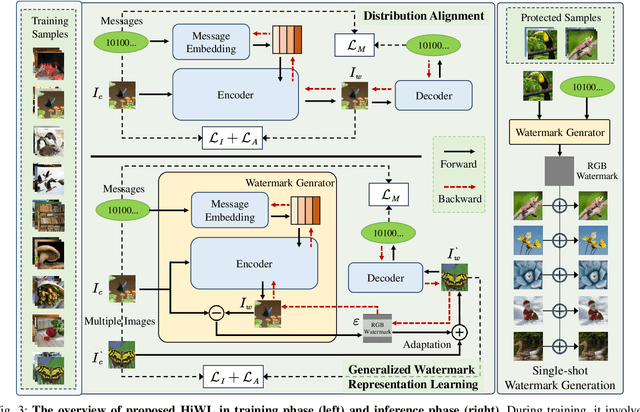
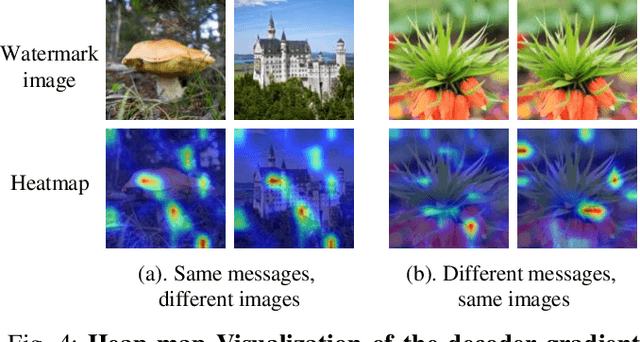
Deep image watermarking, which refers to enable imperceptible watermark embedding and reliable extraction in cover images, has shown to be effective for copyright protection of image assets. However, existing methods face limitations in simultaneously satisfying three essential criteria for generalizable watermarking: 1) invisibility (imperceptible hide of watermarks), 2) robustness (reliable watermark recovery under diverse conditions), and 3) broad applicability (low latency in watermarking process). To address these limitations, we propose a Hierarchical Watermark Learning (HiWL), a two-stage optimization that enable a watermarking model to simultaneously achieve three criteria. In the first stage, distribution alignment learning is designed to establish a common latent space with two constraints: 1) visual consistency between watermarked and non-watermarked images, and 2) information invariance across watermark latent representations. In this way, multi-modal inputs including watermark message (binary codes) and cover images (RGB pixels) can be well represented, ensuring the invisibility of watermarks and robustness in watermarking process thereby. The second stage employs generalized watermark representation learning to establish a disentanglement policy for separating watermarks from image content in RGB space. In particular, it strongly penalizes substantial fluctuations in separated RGB watermarks corresponding to identical messages. Consequently, HiWL effectively learns generalizable latent-space watermark representations while maintaining broad applicability. Extensive experiments demonstrate the effectiveness of proposed method. In particular, it achieves 7.6\% higher accuracy in watermark extraction than existing methods, while maintaining extremely low latency (100K images processed in 8s).